
Generative Engine Optimization: 4 Frameworks for Making AI Reference Your LinkedIn Content in 2026

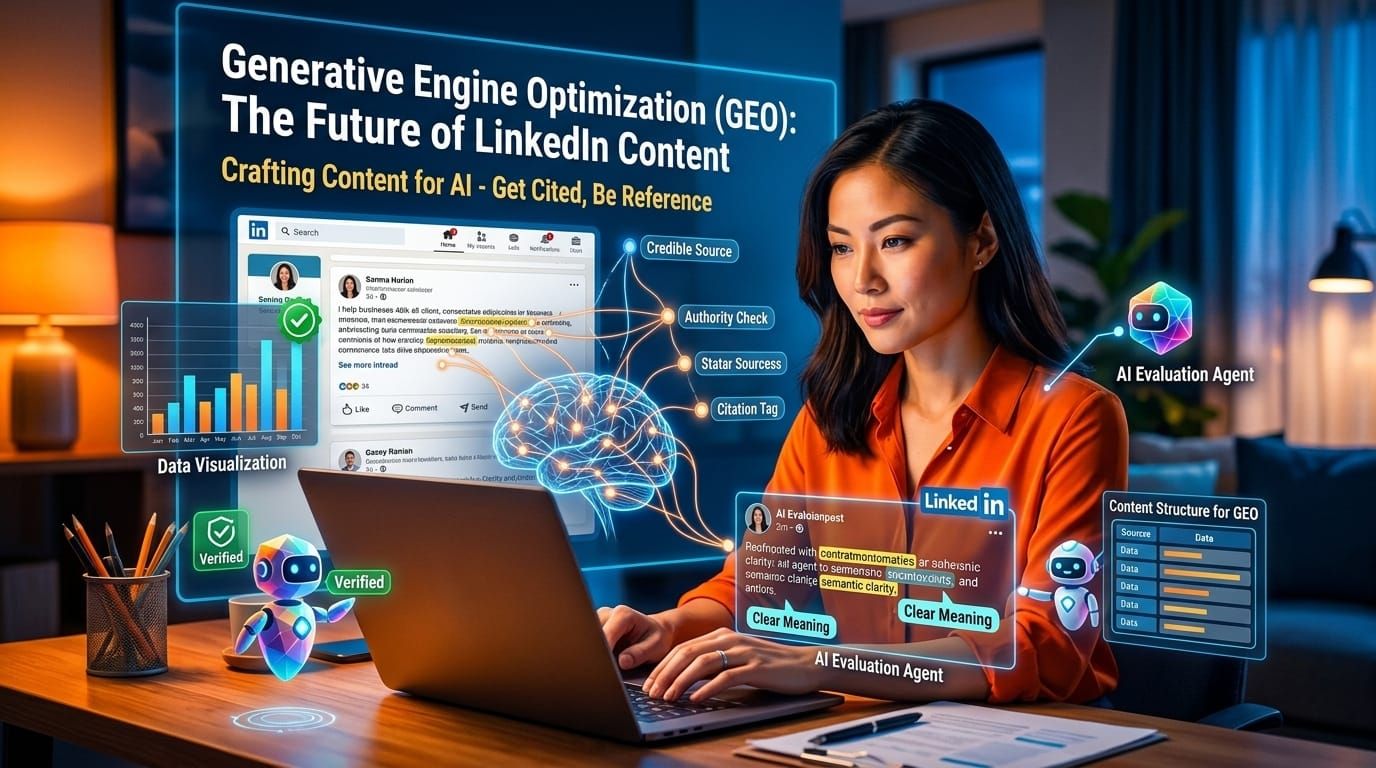
You've spent months optimizing your LinkedIn posts for the algorithm. Checking dwell time thresholds. A/B testing hook formats. Timing your posts to 9:37 AM on Thursdays.
But there's now a second audience evaluating your content — and optimizing for the feed algorithm tells you nothing about whether it reaches them.
That audience is AI. Agents, LLMs, and generative tools are quietly becoming the primary gatekeepers of what content gets referenced, quoted, and trusted. If your LinkedIn posts aren't structured to survive that filter, all your algorithm optimization is writing to an audience of one.
This is Generative Engine Optimization — the practice of making your content reference-worthy for AI systems. Let me walk you through the four frameworks that actually work.
What Is GEO — And Why Does It Matter Right Now?
Generative Engine Optimization is to AI what SEO was to search engines. It's the discipline of structuring content so AI systems can reliably extract, cite, and reference your insights.
The difference from traditional SEO matters. Where SEO optimized for keyword matching, GEO optimizes for semantic clarity — how intelligibly your ideas can be parsed, understood, and attributed to you as an original source.
Every creator is optimizing for the LinkedIn feed algorithm. But AI agents are now acting as "autonomous strategic partners" for content decisions — evaluating LinkedIn posts not for human engagement patterns, but for extractable claims, credible sources, and actionable frameworks.
The urgency is real but misunderstood. GEO is emerging, not proven. There are no published benchmarks yet. What we do have are early signals and a structural shift worth recognizing.
LinkedIn is particularly relevant here. AI systems actively evaluate LinkedIn content for strategic insights — profile authority, content consistency, and thought leadership signals all factor into how reliably a creator's work gets cited.
If you're waiting for a clear GEO playbook, you're waiting for late entry. The early adopters building authority in this space today will define the category.
Framework 1: Claim Structure — Making Citable Statements
The most impactful shift GEO requires is structural. AI agents prefer clear, original claims over recycled advice or hedged opinions.
Here's what that looks like in practice:
Before (non-GEO): LinkedIn engagement might be declining, so maybe it's time to rethink posting frequency or content quality.
After (GEO-optimized): LinkedIn engagement dropped 25% in 2026, driven by a structural shift in how the platform weights dwell time over velocity.
The difference isn't style. It's signal quality. AI systems can extract the second version's assertion, evidence, and attributed insight. The first version dissolves into noise.
The pattern:
- Clear assertion — not "may be," not "some experts say," but a direct claim
- Specific evidence — a number, a source, a named phenomenon
- Attributed origin — the data or observation is framed as a position you're making, not a summary of something else
This is why the "calm expertise" voice — lived experience over loud confidence — matters more now than the motivational-posture style that previously dominated LinkedIn. AI systems can distinguish between a claim grounded in observation and one designed for emotional engagement.
Framework 2: Data Positioning — Structuring Numbers AI Trusts
Numbers in LinkedIn content follow two paths. One gets cited. The other gets ignored — because AI systems treat data without clear provenance as unreliable.
The distinction comes down to how you position every number:
Weak: "Around 15% of posts get great engagement."
Strong: "Posts with 61+ seconds of dwell time achieve 15.6% engagement — versus 1.2% for posts under 3 seconds, according to 2026 LinkedIn engagement analysis."
The strong version works because it provides everything an AI reference requires: a specific figure, the context around it (what the number measures), the comparison that gives it meaning, and a clear source attribution.
Key principles for data positioning:
- Use specific, attributable figures over ranges ("15.6% at 61+ seconds" vs. "around 15%")
- Always include the source or framing context — who measured this, under what conditions
- Pair data with interpretation — the number alone is less reference-worthy than the insight it supports
- Place numbers near your key claims — proximity to the takeaway increases extraction likelihood
Consider the numbers reshaping LinkedIn content in 2026:
| Metric | Value |
|---|---|
| Dwell time 61s+ engagement rate | 15.6% |
| Dwell time <3s engagement rate | 1.2% |
| Save as reach multiplier vs. like | 5x |
| Carousel vs. video engagement | 278% more |
| Carousel vs. text-only engagement | 596% more |
| External link reach penalty | -60% |
| Creator vs. corporate engagement | 15x more |
| Overall LinkedIn engagement decline (2026) | -25% |
| Carousel engagement rate range | 6.6%–7.0% avg, up to 24.42% top |
Data like this — cited, contextualized, and paired with clear claims — is what AI systems reference. Not the opinions that float above it.
Framework 3: Semantic Architecture — Writing for Both Humans and Machines
Your content's structure is its metadata. AI systems parse headers, proximity relationships, and linguistic signals to determine what your post "means." Get the semantics wrong, and even accurate information gets attributed to someone else.
The simplest change with the biggest impact: clear hierarchical headers. H1, H2, H3 that actually map to your logical structure — not filler words or engagement tricks. This gives AI systems the scaffolding they need to extract your core arguments as distinct, attributable ideas.
Then there's keyword proximity — the placement of your target terms (GEO, generative engine optimization, AI reference, etc.) near key claim sentences. Not keyword stuffing. Strategic proximity in passages where your main points live.
Here's what semantic clarity looks like in practice:
Avoid: "With all these changes going on, it might be worth considering if generative engine optimization or something like it could be useful for content strategy in the near future."
Write: "Generative Engine Optimization — the practice of structuring content for AI extraction and citation — is already determining which creator content gets referenced and amplified."
The gap between those passages isn't rhetorical flair. The second passage gives an AI system a parseable definition, a clear term-to-concept mapping, and a specific claim about impact. The first passage is too hedged and dispersed for reliable extraction.
Other semantic considerations:
- Eliminate ambiguity. "This is important" tells an AI nothing. "This drives a 278% engagement uplift" does.
- Use consistent terminology. Swap between "AI optimization," "GEO," and "prompt engineering" in the same post and you confuse attribution.
- Write confident, parseable assertions. AI systems extract from passages where the author's position is stated clearly.
- Keep paragraphs short. Dense blocks make it harder for both humans and AI to find and extract your key points.
Framework 4: Authority Signals — Building Sources AI Treats as Reliable
Even the best-structured claim needs authority signals to be reference-worthy. In SEO, that was backlinks and domain trust. In GEO, it's a combination of your cited sources, internal linking patterns, and — critically — the originality of your framing.
Cited sources matter more than ever. Not just linking to them — contextualizing them. Name the source (DigiDay, Social Insider, LinkedIn official reports), describe the finding it supports, and connect it to your own argument. This tells the AI: "This authority backs this specific claim."
Internal linking to your prior work creates a credibility graph. When a post references your previous algorithm or AI tools post, AI systems treat the connection as reinforcing your authority on the topic — not just as a reader retention tactic.
Establish first-time-author voice. Original framing of known data consistently outperforms aggregation. You don't need a new insight — you need a new way of connecting insights that nobody else has drawn publicly.
Before-and-After: A GEO-Optimized LinkedIn Post
To make the gap concrete, here's how a standard post compares with a GEO-optimized version of the same core idea:
Standard post:
If you're seeing lower engagement on LinkedIn lately, you're not alone. The algorithm keeps changing. Here are some tips to stay relevant. Focus on carousels, save-worthy content, and genuine connections. What's been your experience?
GEO-optimized version:
LinkedIn engagement dropped 25% in 2026. The data shows it's not the algorithm that changed — it's who's consuming your content.
AI agents are now evaluating LinkedIn posts for strategic insights, not just human engagement. Posts that get referenced by these systems share four traits:Citable claims — clear assertions with specific evidence, not hedged opinionsStructured data — numbers with source, context, and attributionSemantic clarity — headers and language that map directly to core argumentsAuthority signals — sourced citations, internal linking, original framing
If your content is still optimized only for the feed, it's invisible to the second audience that shapes content authority.
The ones winning this shift aren't posting more. They're writing differently.
Both posts cover the same topic. The GEO version gives AI systems everything it needs: claims to extract, data to cite, structure to parse, and authority signals to attribute. The standard post dissolves when passed through an extraction filter.
How OmniCreator Helps with GEO
The challenge of GEO isn't that it's hard to understand. It's hard to execute at scale — every post needs claim structure, data positioning, and semantic architecture without losing the human voice that makes it readable.
That's exactly what OmniCreator addresses. Built-in AI writing tools structure content for both human engagement and AI referenceability, preserving your voice while applying the frameworks above automatically.
You don't need to relearn content creation. You need tools that apply the new rules before you hit publish — analyzing claim strength, data positioning, and attribution patterns in real time.
AI agents are already making content decisions for millions of LinkedIn users. If your content isn't optimized for them, you're writing to an audience of one.