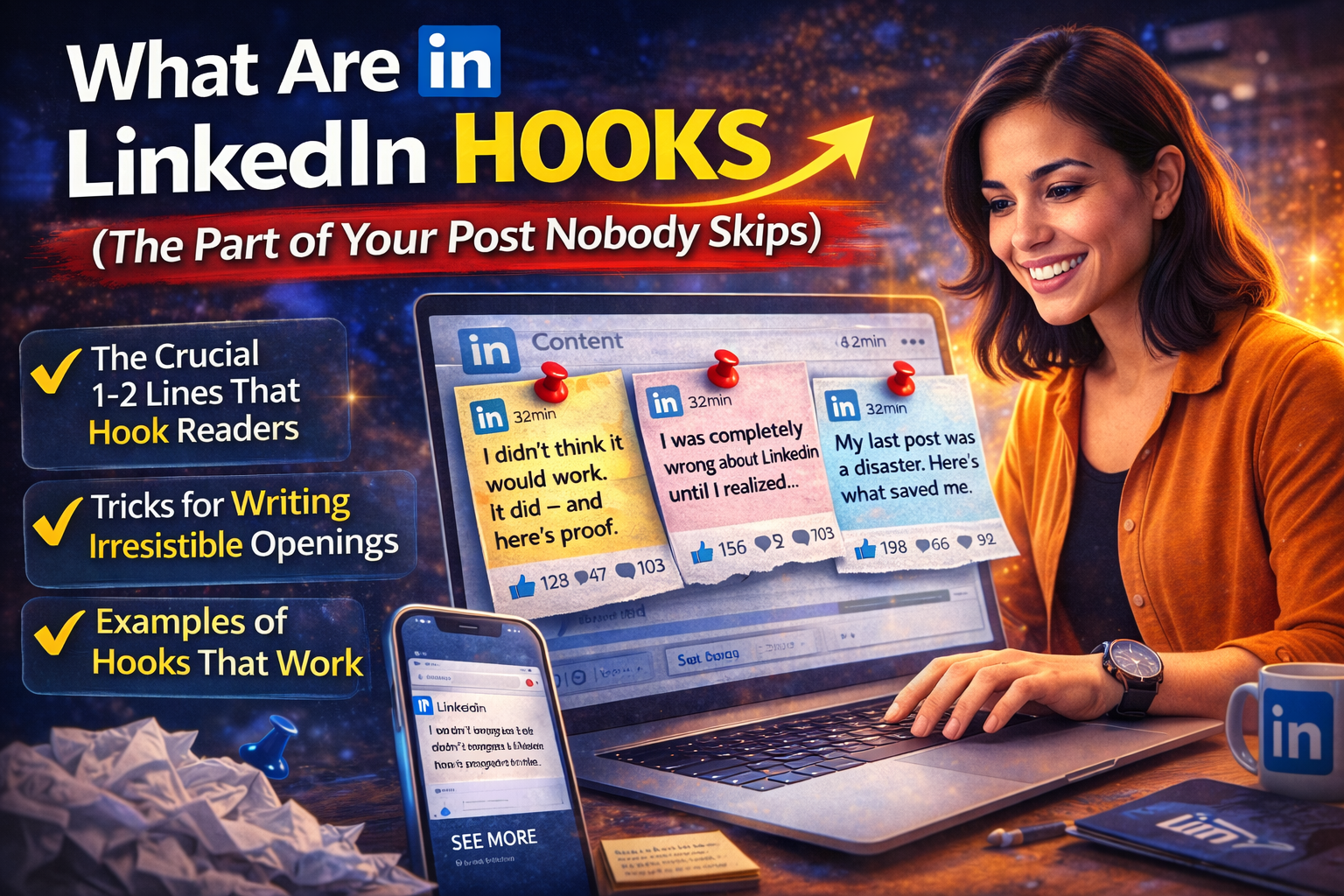
What Are LinkedIn Hooks (The Part of Your Post Nobody Skips)

Most LinkedIn posts fail before the third line.
Not because the idea is bad.
Not because the writing falls apart somewhere in the middle.
But because nobody stopped to think about the hook.
They just started typing and hoped the algorithm was feeling generous that day.
I've been posting on LinkedIn for years and built my audience past 30,000 followers.
The single biggest difference between posts that reach thousands of people and posts that reach forty-seven is almost always the first line.
Not the topic...
Not the length...
Not the hashtags...
But the hook.
What Is a LinkedIn Hook?
A LinkedIn hook is the first one or two lines of your post, the only text visible before the "see more" button cuts off the rest.
That's the whole definition.
But the simplicity is deceptive.
Those first two lines are the entire audition.
LinkedIn's feed moves fast and most people are scrolling on their phone between meetings, during the commute, or while pretending to pay attention to a Zoom call they didn't need to be in.
If the opening line doesn't give them a reason to tap "see more," the rest of the post doesn't exist.
Not to them, and not to the algorithm.
LinkedIn measures dwell time and engagement as signals for how widely to distribute your content.
A weak hook doesn't just lose the reader.
It quietly limits the reach of everything that follows.
Why Do LinkedIn Hooks Determine Whether Anyone Reads Your Post?
LinkedIn hooks determine reach because they determine whether anyone clicks through.
Without clicks, even a well-written post goes nowhere.
Think about how you scroll LinkedIn.
You're not reading every post in full.
You're scanning the first lines.
Something catches your eye, you tap, you read.
Something doesn't, you scroll past without registering who even wrote it.
Your audience is doing exactly the same thing with your content, every single time.
According to LinkedIn's own content strategy research, posts that drive high early engagement get distributed significantly further than posts that start slowly.
The hook drives that early engagement.
A weak opener means low initial clicks, which means the algorithm pulls back distribution, which means fewer people ever see the post at all.
The whole thing collapses in the first two lines.
Three seconds of someone's attention is a generous estimate, and LinkedIn's feed is not known for its generosity.
What Makes a Good LinkedIn Hook?
A good LinkedIn hook does one of three things:
- Makes a specific promise
- Challenges a belief the reader already holds
- Opens a tension that only gets resolved by reading on
The specificity hook leads with a concrete result or number that implies a lesson:
"I lost 40% of my LinkedIn reach in one week. Here's what I changed."
The number is specific.
The implication is clear.
The reader knows exactly what they're getting and whether it's relevant to them, all before the second sentence.
The negation hook kills a common belief and replaces it with a better one:
"Posting daily on LinkedIn isn't a growth strategy. It's a burnout strategy."
It works because it creates instant disagreement or recognition.
Either the reader pushes back and reads to find out why you're wrong, or they feel seen and read to find out what to do instead.
Both are good outcomes.
The tension hook opens a gap the post promises to close:
"Three months ago I was ready to quit LinkedIn entirely."
That's it.
The reader has no idea what happened next, and the only way to find out is to keep reading.
No complicated setup required.
What all three have in common is that they advertise the payoff immediately.
The reader knows by line two what they're getting from this post.
That's the standard every hook should meet.
Not eventually, not in paragraph three, in the first two lines.
What Are Some Examples of LinkedIn Hooks?
Here are examples across all three types, with the flat version of the same idea alongside each one.
- Specificity: Flat: "Here are some thoughts on LinkedIn growth."
Hook: "My last post hit 47,000 impressions. I have 3,200 followers. Here's what was different." - Negation: Flat: "Consistency is important on LinkedIn."
Hook: "Posting every day on LinkedIn without a strategy is just being consistently ignored." - Tension: Flat: "I've learned a lot from my LinkedIn journey."
Hook: "I deleted my best-performing LinkedIn post three hours after publishing it."
The flat versions aren't wrong.
They're just forgettable.
Nobody stops scrolling for "here are some thoughts."
They stop for a number that implies a lesson, a contradiction that demands a response, or a story that clearly started somewhere interesting.
How Do You Write a Good LinkedIn Hook?
Writing good hooks gets easier once you stop trying to write the perfect opener and start with one question: What is this post delivering?
If the post delivers a specific lesson from a mistake, the hook should reference the mistake.
If it delivers a framework, the hook should challenge the approach most people use instead.
If it delivers a counterintuitive finding, state the counterintuitive thing in line one.
Not buried in paragraph three where most people never arrive.
The most common hook-writing mistake is starting with context instead of content.
"Over the past few years, I've been thinking about..." is context.
"The advice I followed for two years was making my LinkedIn worse" is content.
Start with the thing that matters, then add whatever context is needed after you've earned the reader's attention.
A few patterns worth cutting entirely:
"Unpopular opinion:" followed by something extremely popular
"I'm excited to share..."
Anything that opens with "As a [job title]..."
These are so overused that LinkedIn's audience has developed a reflex to scroll past them before finishing the sentence.
You've probably done it yourself today without noticing.
For a deeper look at how hooks fit into a complete post structure, our guide on how to write a LinkedIn post that sounds like you cover the full framework.
How OmniCreator Helps You Catch Weak Hooks Before They Go Live
Writing a strong hook is one thing.
Knowing whether your hook is strong enough before you publish is another.
OmniCreator's Proofread feature reviews your draft before it goes live, including the opening lines specifically.
Is the hook strong enough to hold attention?
Does the first line earn the "see more" tap?
Hit Optimize and the improvements apply automatically.
It's the difference between publishing and hoping versus publishing and knowing.
Most people find out their hook was weak three hours after posting, when the impressions plateau and the engagement never arrives.
That's the wrong time to find out.
Catching it before publishing is what the feature is for.
All of this is part of OmniCreator's broader workflow: scheduling calendar, media library, AI interviewer (Starlog), and Proofread, for $20/month.
The Line That Decides Everything Else
A great hook doesn't guarantee a great post.
But a weak hook guarantees nobody finds out whether the post was great or not.
Start there.
Get the first line right.
Then build the rest of the post around a payoff worthy of it.
If you want help catching weak hooks before they go live, try OmniCreator's Proofread feature.
Write the post, click Proofread, and know whether the opening is strong enough before anything goes public.