
Niche Down to Scale Up: How Micro-Specialization 3-5x Your LinkedIn Authority (And Revenue)

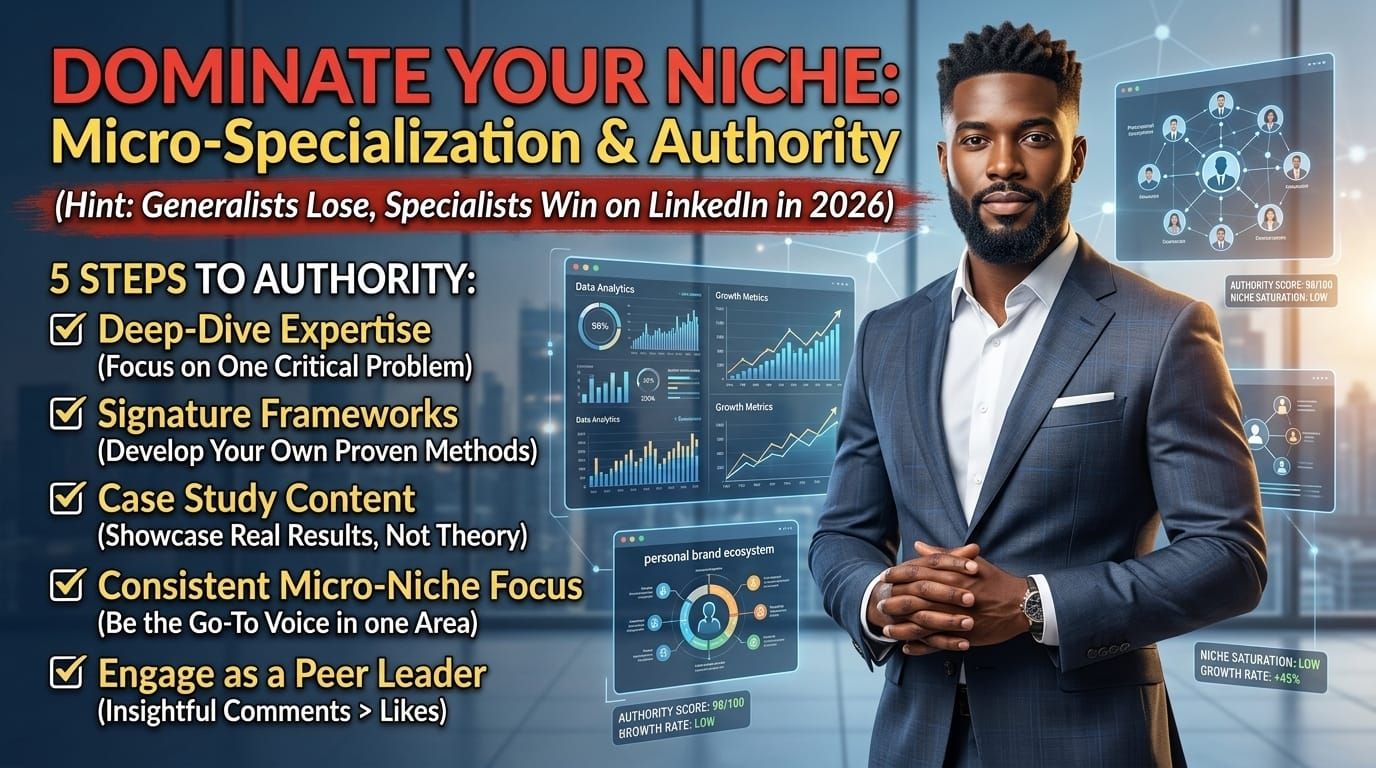
The Specialist Advantage: Real Numbers
LinkedIn is hitting 310M monthly active users in 2025. The noise is deafening.
Yet the people outperforming everyone? They're posting less.
That's because the algorithm changed what it measures. Volume used to work. Now it rewards dwell time, conversation depth, and repeat engagement from the right audience.
Posting to everyone means reaching no one.
Here's what the data shows:
- 67% conversion rate for specialists vs 20% for generalists with referrals
- 3.4x higher conversion rates for niche-focused professionals
- 2x engagement on LinkedIn for micro-niche specialists
- 48% larger initial engagements from specialist-generated leads
- $187K lifetime value (specialist referrals) vs $67K (generalist)
The math is brutal: being everywhere means you're forgettable everywhere.
Why Generalists Are Losing
If you've been posting daily and your reach is flat, you're not alone.
That's because the platform evolved. B2B buyers are smarter now, fatigued by generic content, and they're choosing vendors with strong personal brands. 80% of B2B leads come from social media, and LinkedIn is 277% more effective than other networks for lead generation.
But here's what's happening behind the scenes:
LinkedIn's algorithm now prioritizes professionals who consistently focus on a small set of topics. It boosts their content, shows it to people in their exact niche, and builds a community around their expertise.
Generalists don't get that treatment.
The Micro-Niche Formula (How To Define Yours)
So what do you actually do?
Start with these three questions:
1. What problem do you solve for a specific audience?
Not "I help businesses grow." More like: "I help SaaS founders scale from $1M to $10M ARR by fixing their sales team structure."
2. Who specifically needs this help most?
Not "anyone struggling with sales." More like: "Founder-led B2B companies who've hit revenue plateaus at $1.5M."
3. Why you, specifically?
What unique experience, perspective, or approach makes you the obvious choice for that person?
This isn't about limiting opportunities. It's about being "selectively famous" among the people who can actually move your career forward.
The T-Shaped Professional (Hybrid Approach)
Here's the nuance: the most successful people in 2025 aren't pure specialists or pure generalists. They're T-shaped:
- Broad understanding across their field (generalist baseline)
- Deep expertise in one or two specific areas (specialist differentiation)
This gives them adaptability without losing authority. They can speak the language of multiple departments, but they're the obvious go-to for their specific domain.
Content Strategy for Micro-Niche Dominance
The winning mix in 2025:
Short-form content (3-5x/week): 200-300 word posts that deliver one specific insight. Think: "How to" guides, quick frameworks, specific mistakes to avoid.
Deep-form content (1-2x/month): Longer posts or documents that establish your full methodology. Case studies, comprehensive guides, behind-the-scenes of your actual work.
Video (2-3x/week): Native video under 90 seconds is generating 4-6x more reach. Keep it authentic, not over-produced.
Community building: Respond to comments, initiate discussions, build micro-communities through private groups or newsletters. The conversation in the comments often leads to actual deals.
The Trust-to-Revenue Pipeline
Personal branding has shifted from career tool to sales funnel. The progression is:
Visibility → Trust → Dialogue → Deal
A significant majority of B2B buyers now choose vendors with strong personal brands. They want to know the humans behind the companies. They want to trust before they transact.
That means showing up consistently with value, building real relationships, and positioning yourself as the obvious expert for your specific niche.
What This Looks Like in Practice
Let me give you a concrete example:
Generalist positioning: "I'm a consultant who helps companies improve their sales performance."
Micro-niche positioning: "I help founder-led B2B SaaS companies scale past $2M ARR by fixing their sales process. Specifically, I've helped 23 companies add $500K-$1.5M in annual revenue by optimizing their sales cycle."
The difference is immediate:
- The first person gets generic questions from everyone
- The second person gets targeted inquiries from ideal prospects
Same effort, dramatically different results.
Why This Works (The Psychology)
It's not magic, it's cognitive psychology:
When you're specific, you're memorable. When you're memorable, you're top-of-mind when that specific problem arises. When you're top-of-mind, you're the obvious choice.
Generalists create choice paralysis for potential clients. Specialists create immediate clarity.
The Counterintuitive Truth
Here's what I see weekly:
People who slowed down their posting frequency while doubling down on niche specificity are now outperforming the people who quadrupled their output and diluted their focus.
Quality finally has algorithmic backup on LinkedIn.
The people who niche down are building unshakeable authority, commanding higher fees, and attracting better opportunities. They're not reaching more people, but they're reaching the right people.
Your Move
The question isn't whether you should niche down. It's whether you're willing to stop trying to appeal to everyone.
Because in 2025, being selectively famous is the fastest path to real influence and real revenue.
Sources & Research:
- LinkedIn platform trends and algorithms (2025 data)
- ConsSource Referral Pattern Analysis (67% vs 20% conversion rates)
- B2B lead generation statistics (80% from social, LinkedIn 277% more effective)
- Micro-niche personal branding strategy research (2025)
- Specialist vs generalist performance metrics
- T-shaped professional framework analysis
Key References:
- Factory Communication (LinkedIn personal branding trends)
- Scion Social (micro-niche positioning strategies)
- Vertex AI Search (platform algorithm insights)
- TACTUS (B2B marketplace evolution)
What's your micro-niche? Share your specific positioning in the comments — I'm interested in seeing how people are differentiating themselves in 2025.
Want to catch weak hooks before they go live?
Try OmniCreator's Proofread feature. Write your post, click Proofread, and know whether the opening is strong enough before anything goes public. 👉 Try OmniCreator's Proofread